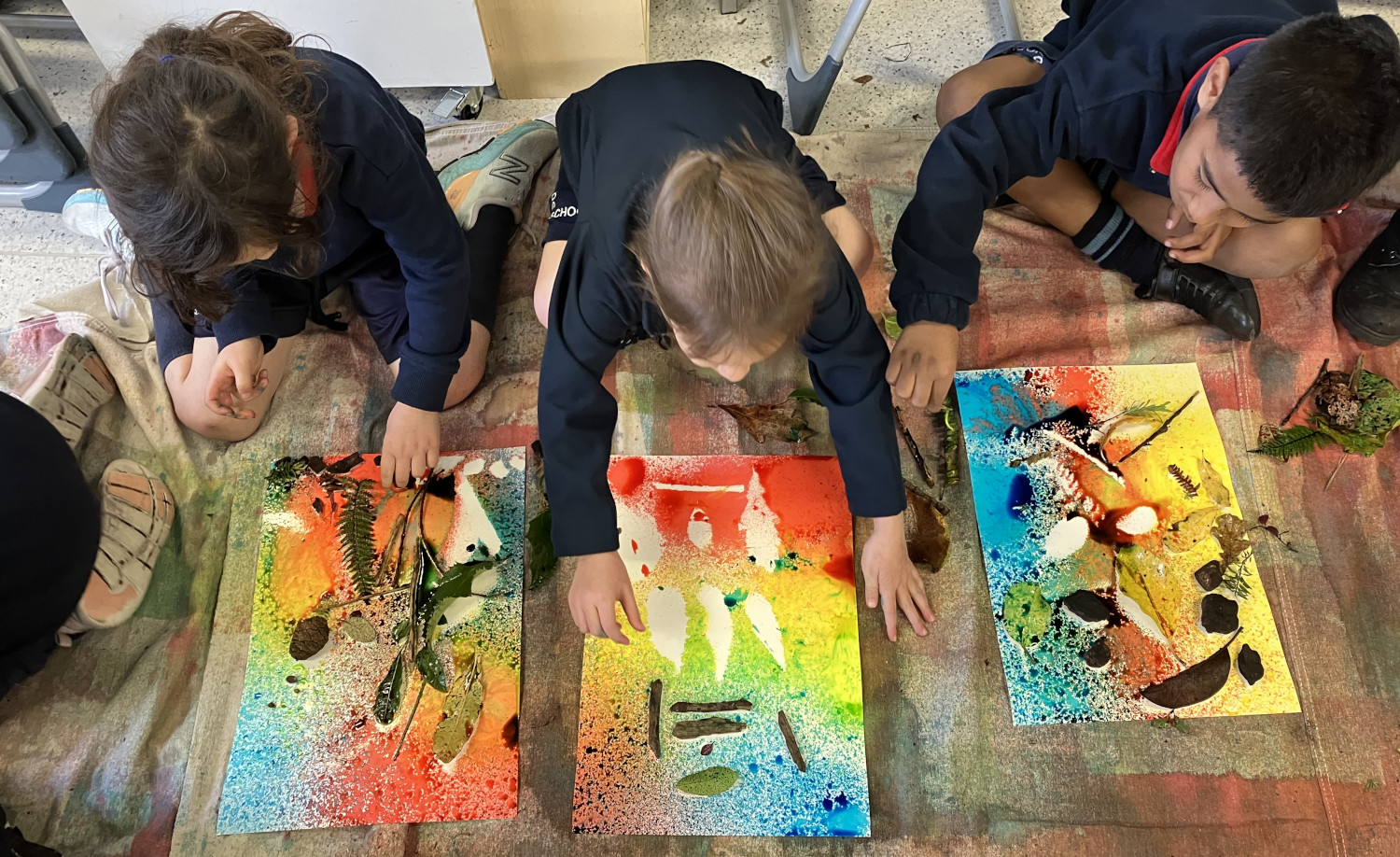
Image: SCAPE Public Art Education Workshop, nature dye prints responding to Julia Morison, Tree Houses for Swamp Dwellers (photo: Sarah Ackerley)
We currently have seven modules on offer, stimulating creative response to five different pieces of public art in Ōtautahi Christchurch.
When, where, what: the basics
- Up to 30 ākonga per session
- 90 minutes per session
- Up to 3 sessions per day
- Can work within school timetables
- Outreach onsite at your school/community space or at Tūranga library
- Tuesdays and Thursdays
- Can tailor to suit specific learning and achievement objectives and inquiry topics
- Aimed at Level 1 – 4 of NZ Curriculum, but open to all ages
Lesson structure: common across all Education Workshops
- Introduction to SCAPE and the artist/artwork that inspired the workshop (20 mins)
- Creating time (60 mins)
- Reflection (10 mins)
SCAPE Education Workshops Details for Teachers
Jon Jeet, He Toki Maitai: Pendant Making
Workshop description and outcome: Jon Jeet draws on his combined Ngāti Maniapoto and Fijian Indian whakakpapa in creating the corten steel toki form which reflects his practice as a pounamu carver and his family’s journey to Aotearoa as labourers. The art-making inspired by this uses design processes that explore the symbolism used in pounamu carving to create pendants with shrink plastic.
NZC Achievement Objectives
Developing Practical Knowledge
- Use drawing conventions and construction materials to explore elements of shape, line and colour to create a symbolic pendant design
Developing Ideas
- Develop and refine ideas for their pendant inspired by the symbolism used in pounamu designs
Communicating and Interpreting
- Describe the symbolism used in their pendant and what it represents
- Understand the concept of whanaungatanga, sharing how their pendants reflect honour the relationship between the giver and receiver
Understanding in Context
- Explore Jon Jeet’s He Toki Maitai as a public artwork, understanding how it reflects his whakapapa, speaks to the tradition of the craft of pounamu carving and connects with its local community
Peter Atkins, Chaos and Order – Under Construction: Abstract Watercolour
Workshop description and outcome: This artwork features a different pattern on each side of a billboard. One side is arranged randomly, evoking the idea of Chaos and reflecting the uncertainty, confusion, and frustration experienced after the Christchurch earthquakes. The other side, reimagined following the Mosque shootings, presents Order through imagery inspired by Islamic art motifs, suggesting the broken fragments of chaos being gathered and carefully repositioned. The accompanying art-making activity is a watercolour project focused on abstract pattern-making to represent these two opposing ideas.
NZC Achievement Objectives:
Developing Practical Knowledge
- Explore and use tape resist watercolour techniques and abstract use of line, shape, colour and pattern to create a painting
Developing Ideas
- Develop and refine abstract visual ideas that represent the contrast between chaos and order
Communicating and Interpreting
- Describe how abstract imagery can be used to communicate specific feelings and ideas
Understanding in Context
- Investigate how Chaos and Order – Under Construction responds to social and cultural events, recognising how visual art can reflect collective experiences and draw inspiration from cultural traditions such as Islamic art.
Sēmisi Fetokai Poutauaine, VAKA ‘A HINA: Geometric Forms
Workshop description and outcome: This artwork draws on Tongan and Pacific folklore, in which Hina, a Tongan goddess, travels between earth and the moon in her vaka (canoe/vessel). The towering abstract sculpture uses triangular geometric forms to evoke ideas of travel, motion, and movement. The accompanying activity is a printmaking workshop focusing on repetition and the layering of abstract shapes, patterns, and forms inspired by Tapa cloth design.
NZC Achievement Objectives:
Developing Practical Knowledge
- Explore and use printmaking techniques to create a layered image inspired by the shapes and patterns found in tapa cloth design.
Developing Ideas
- Generate and develop abstract visual ideas by experimenting with repetition, layering, and geometric forms to explore concepts of movement and journey
Communicating and Interpreting
- Describe how their artwork uses layering and repetition of abstract forms to communicate ideas around movement and journey
Understanding in Context
- Understand how artists use abstract forms to communicate stories and ideas drawn from Pacific cultural traditions.
Julia Morison, Tree Houses for Swamp Dwellers: three options
This post-quake modular artwork incorporates light and plant forms, creating spaces for reflection and play. The art-making activities inspired by this work include cyanotype printmaking, nature-dye prints and loose-parts sculpture.
Option 1: Cyanotype Printmaking
Workshop description and outcome: Cyanotype printmaking is a photographic process that can be thought of as drawing with light and shadow. Using light sensitive paper ākonga will create a cyanotype print. Ākonga will learn about composition techniques, the use of positive and negative space through silhouette forms and investigate shape, line, form, and pattern through object placement. This workshop requires a sunny day. The nature dye print alternative can be used if the weather forecast is not looking good.
NZC Achievement Objectives:
Developing Practical Knowledge
- Use cyanotype printmaking techniques to explore the relationship between light, shadow, and object placement to create different visual effects.
Developing Ideas
- Experiment with forms, layering and the use of positive and negative space to refine composition arrangements
Communicating and Interpreting
- Understand and describe the meaning of art terminology specific to the workshop: composition, silhouette, positive and negative space
Understanding in Context
- Understand how public artworks respond to place, environment, and shared experiences, including post-quake contexts.
Option 2. Nature Dye Prints
Workshop description and outcome: This workshop is similar to cyanotype printmaking, in understanding composition and silhouette forms, however ākonga will also explore basic colour theory to produce a print using spray dye techniques.
NZC Achievement Objectives:
Developing Practical Knowledge
- Use printmaking techniques to explore the relationship between light, shadow, and object placement to create different visual effects.
- Understand basic colour theory of how the primary colours can be used to creat secondary colours
Developing Ideas
- Experiment with forms, layering and the use of positive and negative space to refine composition arrangements
Communicating and Interpreting
- Understand and describe the meaning of art terminology specific to the workshop: composition, silhouette, positive and negative space
Understanding in Context
- Understand how public artworks respond to place, environment, and shared experiences, including post-quake contexts.
Option 3: Loose Parts Sculpture
Workshop description and outcome: In this workshop ākonga create a treehouse themed sculpture through a series of construction challenges using loose parts. Ākonga will experiment with form, shape, balance, and structure in three dimensions and how materials can be combined to create visual interest.
NZC Achievement Objectives:
Developing Practical Knowledge
- Use construction techniques and loose materials to explore form, shape, balance, and structure in three-dimensional sculptures.
Developing Ideas
- Develop and refine sculpture ideas by experimenting with material combinations and spatial arrangements to create visual interest.
Communicating and Interpreting
- Describe how their artwork uses 3D forms to respond to the three design challenges of creating: a space to rest, a space to play and something for plants to grow up
Understanding in Context
- Understand how public artworks respond to place, environment, and shared experiences, including post-quake contexts.
Kazu Nakagawa, Ka Mua, Ka Muri: 3D Paper Construction
Workshop description and outcome: “Ka mua, ka muri” is a Māori whakataukī that speaks to walking backwards into the future, encouraging reflection on past experiences to guide the path ahead. The sculpture comprises two large interdependent rings leaning together for support. It was gifted to the people of Ōtautahi after the terror attacks, with the hope that it would offer a place for reflection and embody the strength of a community that uplifts one another. Inspired by Kazu’s use of origami folding techniques in the creation of this artwork, the art-making activity introduces students to paper construction methods for building a three-dimensional sculpture. Through this process, ākonga explore form, structure, and the relationship between two interdependent elements.
NZC Achievement Objectives:
Developing Practical Knowledge
- Use paper construction techniques to explore elements of shape and form and create a 3D sculpture
Developing Ideas
- Develop and refine shapes and forms through investigating different techniques and solving construction problems
Communicating and Interpreting
- Show understanding of how the artwork Ka Mua Ka Muri reflects on the whakataukī it is named after
Understanding in Context
- Explore Kazu Nakagawa’s Ka Mua Ka Muri as a public artwork, reflecting on the Christchurch mosque attacks and community connection