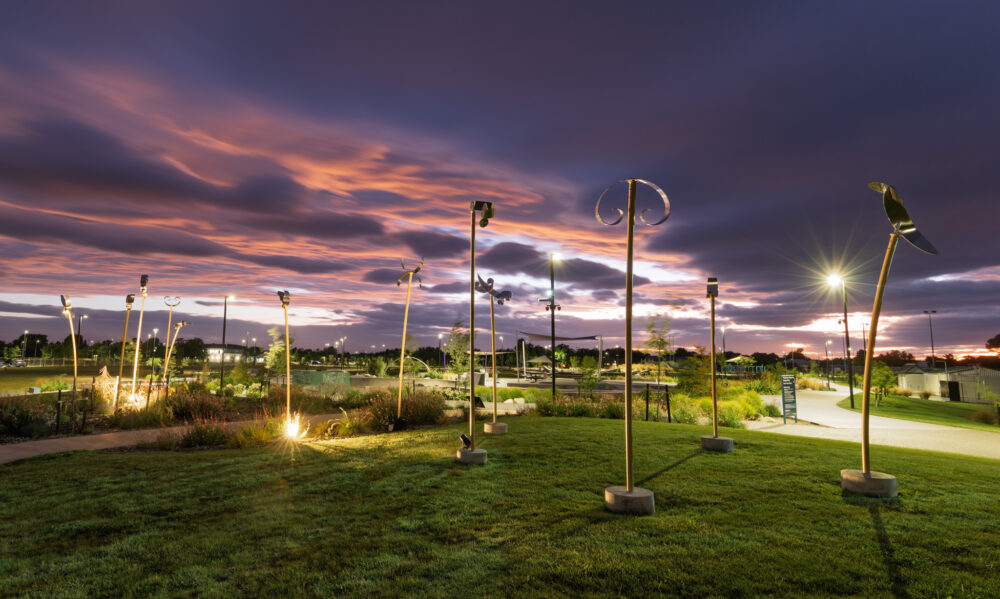
Toro Atua, by Dr Areta Wilkinson (Ngāi Tahu), is intended as a legacy for future generations.
It is permanently located in Rolleston Town Centre, Selwyn District, in the reserve next to Te Ara Ātea, Rolleston’s cultural and community hub.
Dr Wilkinson’s distinctive, meaningful public artwork takes inspiration from ancestral rock art of Te Waipounamu. The work is comprised of twenty light-reflecting stainless-steel figures, mounted on tall, slender poles to vibrate with life, shimmering slightly in the air above people’s heads. The tallest poles are four metres high and the figures are arranged in groups throughout the reserve, leading people through the landscape and indicating areas of importance.
Toro Atua was commissioned by a panel from the Rolleston Residents’ Association, Selwyn District Council, SCAPE Public Art and Ngāi Te Ruahikihiki ki Taumutu, following a competitive selection process. SCAPE Public Art fund-raised over 50% of the project budget to supplement historical council funds that had been set aside for a public artwork.
Toro Atua adds an important voice and perspective to the narrative of the region, reflecting Selwyn’s environmental history and unique cultural identity. Dr Wilkinson conceived the artwork as imagined guardians; timeless swimming, standing or flying creatures. Her vision was for a recognisable herald of the Rolleston community hub that also sits in harmony with its landscape, delighting and intriguing residents and passersby.
For the opening event, in July 2024, Selwyn District Mayor Sam Broughton said, “watching the work take shape, I’m sure that the artist has more than achieved her vision of creating a distinctive herald of Rolleston, which will delight and intrigue residents and visitors.” Toro Atua is another sign of Rolleston, and Selwyn District, coming of age, “not only are we the fastest growing centre in the region, but we are also becoming more confident in embracing and celebrating our distinctive landscape and cultural heritage.”
The sculpture draws on the cultural narrative for Te Ara Ātea gifted to Selwyn District Council by mana whenua, Ngāi Te Ruahikihiki ki Taumutu. Ruahikihikitanga Portfolio Leader, Puamiria Parata-Goodall has welcomed the artist’s sensitive response to mana whenua stories. “Toro Atua reflects many strands of the narrative, where we speak to the whakapapa, kōrero and mahinga kai traditional food and resource practices. Another key aspect is the importance of the site as a pouwhenua or marker in the network of traditional and contemporary trails across the landscape of Tauwharekākaho Rolleston.”
In the artist’s own words: “objects become taonga through the community of care around them. Already many people have contributed their energy and skill to this project. My hope is that Toro Atua will become integral to the sense of identity and landscape of generations of local people.”
SCAPE thanks the project’s funders and sponsors, who made the work possible. They are:
- Selwyn District Council
- Rolleston Residents’ Association
- Creative New Zealand
- CORDE
- ENI Engineering Ltd
- Rolleston family
- Rātā Foundation
- Te Rūnanga o Ngāi Tahu
- Ngāi Te Ruahikihiki ki Taumutu
- Rolleston Fields
- Hughes Construction
- Isaac Group
- IPort Business Park
- TM Consultants
- Tawera Studios
- DMC Art
More about the artwork
Themes
In developing this artwork, Dr Areta Wilkinson identified three premises arising from the cultural narrative of Ngāi Te Ruahikihiki ki Taumutu about the original village Orariki. These premises are:
Mauri: the life-giving force. In this artwork, “mauri is expressed through an assembly of imagined figures teaming with liveliness. Semblances of feathered, land-bound or marine creatures, these characters both familiar and other worldly vibrate with life from their elevated stations high above our heads,” says Dr Wilkinson.
Mahinga Kai: natural resources and the traditional practices of harvesting, preparation and storage, according to the seasons, which entailed migration through the landscape.
Pouwhenua: identity markers indicating boundaries, wayfinding, and ancient trails. “Toro means to scout, explore and extend. Toro Atua are divine scouts sent forth to search, guide and scrutinise our movement and impact on this whenua,” says Dr Wilkinson.
Visual Language
Toro Atua employs an original visual language developed by the artist, drawing inspiration from ancestral rock art. The artist invites us to be curious and use our imagination when we look at Toro Atua. “Forms are evocative – bearing a hint or trace of something we recognise,” she says.
Relationship to broader creative practice
Dr Wilkinson sees Toro Atua as part of a broader exploration of mahinga kai, which can also be seen in smaller works shown in recent years, including in:
Paemanu: Tauraka Toi. A Landing Place, Dunedin Public Art Gallery, 2021-22


